PJURE™ Technical White Paper
Filtration Design, Materials, Testing Frameworks & Scientific Basis
1. Purpose and Scope
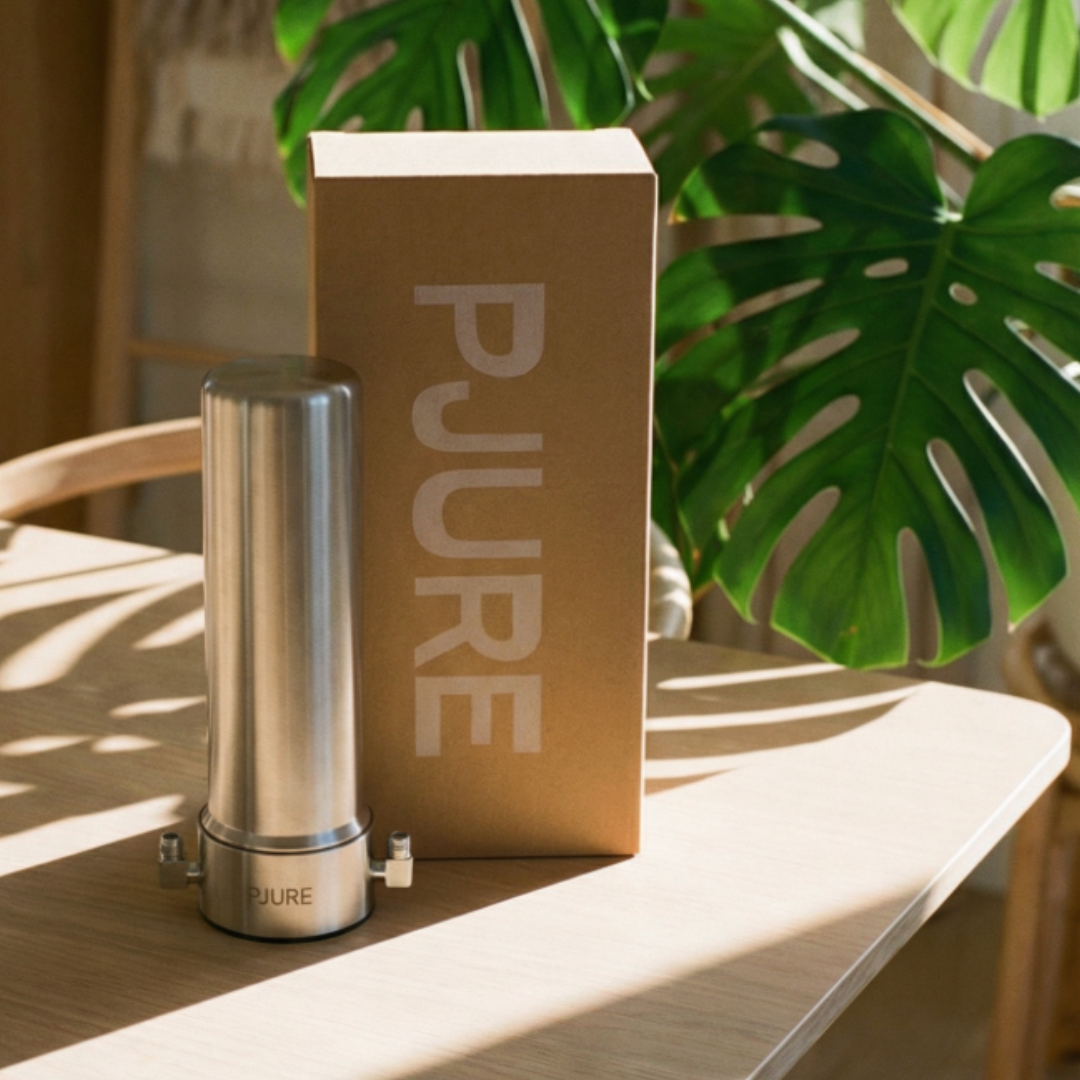
This technical white paper describes the design, materials, filtration mechanisms and scientific basis of the PJURE stainless steel under-sink water filtration system.
The purpose of this document is transparency.
Rather than relying on marketing language or wellness claims, this paper explains how the filtration system is constructed, what each filtration layer is designed to do, which standards inform its evaluation, and how independent scientific research supports the underlying filtration principles.
This document does not replace regulatory certification. It provides technical context for how the system works and how its design aligns with established drinking water treatment practices.
2. System Overview
PJURE is a multi-stage, under-sink water filtration system designed for everyday drinking water use in European households.
The system is engineered to:
- reduce unwanted substances commonly found in municipal tap water,
- preserve naturally occurring minerals,
- maintain stable flow and long service life,
- and ensure material safety in contact with drinking water.
The filtration assembly is housed in stainless steel and consists of the following sequential layers:
- Non-woven PET pre-filter
- Activated carbon block (coconut shell based)
- KDF media (copper–zinc alloy)
- Polypropylene (PP) membrane
- Mineralizing media (calcite and maifanite)
Each layer performs a defined function. No single filtration medium is intended to address all contaminant categories alone.
3. Filtration Layers and Mechanisms
3.1 Non-woven PET Pre-Filter
Material: Polyethylene terephthalate (PET)
Filtration accuracy: ~200 microns
Function: Mechanical interception of large particles
The first filtration stage removes coarse particulate matter such as sand, rust and sediment. This protects downstream filtration media from fouling and extends overall system lifespan.
Non-woven PET filters are widely used in drinking water systems due to their mechanical stability, chemical inertness and suitability for food-contact applications.
This layer does not alter water chemistry and does not shed microplastics. It is designed to intercept particles, not release them. Microplastics are typically introduced through environmental fragmentation rather than intact filtration media operating under controlled flow and pressure conditions.
PET non-woven filters are widely used in drinking water systems due to their mechanical stability, chemical inertness and suitability for food-contact applications.
This layer does not alter water chemistry and does not shed microplastics. It is designed to intercept particles, not release them.
Supported by:
- Standard drinking water pre-filtration practice¹
3.2 Activated Carbon Block
Material: Coconut shell activated carbon with UHMWPE binder
Filtration accuracy: ~3 microns
Filtration mechanism: Adsorption
Activated carbon removes contaminants through adsorption, where dissolved organic molecules bind to the internal pore structure of the carbon.
This filtration stage is responsible for reducing:
- residual chlorine,
- taste and odor compounds,
- volatile organic compounds (VOCs),
- disinfection by-products,
- and a wide range of organic micropollutants.
The PJURE system uses a block carbon design to ensure consistent contact time and reduce channeling.
PFAS context
Activated carbon is the most widely studied and recommended point-of-use treatment method for PFAS adsorption. Research shows strong adsorption of long-chain PFAS and variable reduction of some short-chain PFAS, depending on carbon quality and contact time.
PJURE does not claim PFAS-specific certification. The system uses the filtration mechanism most strongly supported by current scientific consensus for PFAS reduction in household systems.
Supported by:
- WHO²
- U.S. EPA³
- peer-reviewed PFAS adsorption studies⁴
3.3 KDF Layer (Copper–Zinc Media)
Material: Copper and zinc alloy (approximately 1:1)
Filtration mechanism: Oxidation-reduction (redox) reactions
KDF media operates through controlled redox reactions between copper and zinc surfaces as water passes through the media.
These reactions:
- reduce free chlorine,
- reduce certain dissolved heavy metals such as lead and mercury,
- inhibit bacterial growth within the system,
- reduce oxidative stress on the activated carbon layer.
KDF does not adsorb contaminants and is not a physical filter. Its function is chemical transformation and system stabilization.
Supported by:
- NSF / WQA technical documentation⁵
- peer-reviewed redox filtration research⁶
3.4 Polypropylene (PP) Membrane
Material: Food-grade polypropylene
Filtration accuracy: ~25 microns
Function: Fine particle interception and polishing
This membrane captures residual particles and carbon fines released from upstream filtration stages. It improves water clarity, stabilizes flow and protects the mineral media.
Polypropylene is commonly used in drinking water systems due to its chemical stability and low extractables.
Supported by:
- Drinking water material safety standards⁷
3.5 Mineralizing Media
Materials: Calcite and maifanite
Function: pH stabilization and mineral balance support
The final filtration stage stabilizes water chemistry after contaminant reduction.
- Calcite supports pH balance and calcium stability.
- Maifanite is a porous silicate mineral traditionally used in water treatment to support mineral interaction and taste balance.
This layer does not add synthetic electrolytes or deliver nutritional doses. It preserves and stabilizes minerals already present in the source water.
Public health research shows that minerals in drinking water are bioavailable and contribute to taste and overall water quality.
Supported by:
- WHO⁸
- peer-reviewed mineral bioavailability research⁹
4. Testing Frameworks and Performance Results
4.1 Testing Frameworks and Methodologies
PJURE’s filtration system is designed and evaluated using internationally recognized drinking water standards and testing methodologies.
System design, material selection and performance evaluation are informed by established frameworks commonly used in household water filtration, including:
- NSF/ANSI 42 methodologies for aesthetic effects such as chlorine reduction
- Material safety standards for food-contact components
- Third-party laboratory testing protocols for filtration media
While PJURE is not certified under all NSF standards, the filtration principles and materials used align with the performance requirements described within these frameworks.
This approach ensures that system performance is evaluated using criteria consistent with internationally accepted benchmarks, without overstating certification status.
4.2 Performance Testing
Third-party performance testing has been conducted to evaluate filtration performance under controlled laboratory conditions representative of household use.
Testing focused primarily on:
- reduction of free chlorine
- system stability over time
- material integrity during filtration
Tests were conducted using:
- defined influent water quality
- controlled flow rate and pressure
- standardized test durations
Testing protocols were aligned with NSF/ANSI 42 evaluation principles for aesthetic effects.
Results demonstrate consistent and significant reduction of free chlorine across the tested service life of the filtration media.
4.3 Independent Performance Testing (Chlorine Reduction)
PJURE’s activated carbon filtration media has been independently tested by a third-party laboratory using testing conditions aligned with NSF/ANSI 42 methodologies for aesthetic effects (chlorine reduction).
The purpose of the test was to evaluate chlorine reduction performance and stability over time under controlled laboratory conditions representative of household use.
Test overview:
- Test laboratory: Qingdao Co., Ltd (independent third-party laboratory)
- Test date: January 2025
- Test method: NSF/ANSI 42 (methodology reference)
- Flow rate: 5.4 L/min
- Pressure: 60 PSI
- Water temperature: 25 °C
- Influent free chlorine: 1.8–2.2 mg/L
- Total test volume: 3,000 liters
Chlorine Reduction Performance
Independently tested under laboratory conditions aligned with NSF/ANSI 42 methodologies for aesthetic effects (chlorine reduction).
| Filtered Volume | Chlorine Reduction |
|---|---|
| Initial | 98.88 % |
| 750 L | 99.10 % |
| 1,500 L | 98.39 % |
| 2,250 L | 99.44 % |
| 3,000 L | 99.09 % |
Results demonstrate stable chlorine reduction performance across the full 3,000-liter laboratory test cycle. Actual performance may vary depending on water quality, usage patterns and operating conditions.
Conclusion from laboratory report
The filter demonstrates extremely stable chlorine adsorption across the full 3,000-liter laboratory test cycle.
These results indicate consistent chlorine reduction performance over time, with no significant decline observed throughout the tested volume.
How to Interpret These Results
- The test focuses specifically on chlorine reduction, which is the primary aesthetic contaminant in municipal tap water.
- Results reflect controlled laboratory conditions. Actual performance may vary depending on local water quality, usage patterns and operating conditions.
- Chlorine reduction testing is commonly used as a proxy for evaluating activated carbon performance and media stability.
5. Material Safety
All materials used in the PJURE filtration system are selected for long-term stability, durability and suitability for contact with drinking water.
The stainless steel housing is corrosion-resistant and designed for extended service life. Polymer components are food-grade, BPA-free, and selected for low extractables and chemical inertness.
Filtration media are evaluated for material integrity to ensure that no unintended substances are introduced into the filtered water during normal operation.
Material safety is treated as a foundational requirement, independent of filtration performance.
6. Scientific Foundation
The filtration principles applied in the PJURE system are based on established drinking water treatment science.
Each filtration layer corresponds to mechanisms widely documented in peer-reviewed research and public health guidance, including adsorption, redox reactions, mechanical interception and mineral stabilization.
Rather than introducing experimental or proprietary treatment concepts, PJURE applies conservative, well-understood technologies in a multi-stage configuration supported by independent scientific literature.
7. Real-World Lifespan
The PJURE filtration system is designed to deliver consistent performance under everyday household usage.
Pre-filtration reduces particulate load, KDF media limits oxidative stress, and block carbon construction minimizes channeling. Together, these design choices support predictable filter lifespan and stable filtration performance over time.
Recommended replacement intervals are based on typical household consumption patterns and practical use conditions. Actual lifespan may vary depending on source water quality and daily water usage.
8. Compliance with International Standards
PJURE is designed and evaluated in alignment with internationally recognized drinking water treatment standards and material safety frameworks.
These include NSF/ANSI methodologies for aesthetic effects, food-contact material regulations, and relevant European and international guidance on drinking water safety.
Where formal third-party certification is not explicitly claimed, system design, material selection and testing approaches are nevertheless informed by the same technical requirements used within these standards.
This approach ensures regulatory awareness without overstating certification status.
9. Conclusion
PJURE’s filtration system is based on established drinking water treatment principles and supported by independent scientific research.
Each filtration layer performs a defined role. No claims are made beyond what the filtration mechanisms and available research support.
Clean water does not require marketing language. It requires documentation.
References
- WHO. Guidelines for Drinking-water Quality.
https://www.who.int/publications/i/item/9789241549950 - WHO. Drinking-water treatment and safety.
https://www.who.int/teams/environment-climate-change-and-health/water-sanitation-and-health - U.S. EPA. Granular Activated Carbon Drinking Water Treatment.
https://www.epa.gov/water-research/granular-activated-carbon-drinking-water-treatment - ACS Environmental Science & Technology. PFAS adsorption studies.
https://pubs.acs.org/journal/esthag - Water Quality Association (WQA). KDF Filtration Media.
https://www.wqa.org/learn-about-water/water-treatment-products/kdf - PubMed. Copper-zinc redox filtration research.
https://pubmed.ncbi.nlm.nih.gov/ - European food-contact material safety frameworks.
https://ec.europa.eu/food/safety/chemical_safety/food_contact_materials_en - WHO. Nutrients in Drinking Water.
https://www.who.int/publications/i/item/924154995X - PubMed. Mineral bioavailability from drinking water.
https://pubmed.ncbi.nlm.nih.gov/