

Why Reverse Osmosis Removes Minerals (EU 2026 Guide)
Compartilhe este artigo
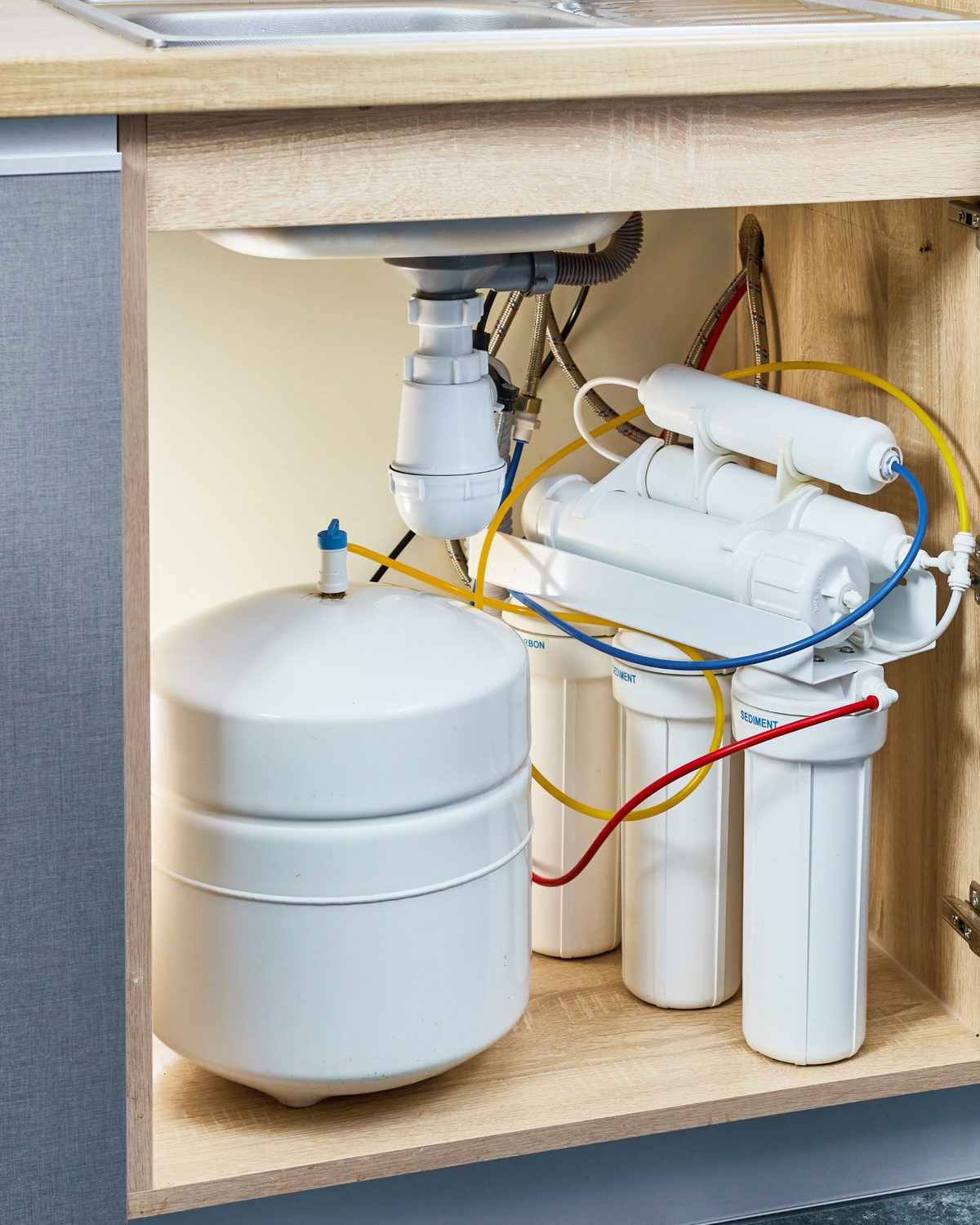

Reverse osmosis removes minerals because its membrane holds back almost all dissolved ions, and calcium and magnesium are dissolved ions. The membrane can’t tell the minerals you want from the substances you don’t, so it removes both.
Quick answers
- How RO works: pressure pushes water through a semi-permeable membrane with pores far smaller than dissolved salts.
- What it removes: most dissolved salts and minerals, many metals and many organic compounds.
- Result: water very low in minerals that often tastes flat and is slightly acidic.
- Workaround: many RO systems add a remineralisation cartridge afterwards.
- Filters that keep minerals: activated carbon and KDF media don’t remove calcium and magnesium.
Minerals are ions, not particles
Calcium and magnesium are not tiny grains floating in the water. They are dissolved as charged ions (Ca²⁺, Mg²⁺) together with bicarbonate, sulphate and chloride. A sediment filter or a carbon block lets them pass. A reverse-osmosis membrane is fine enough to hold most of them back, along with sodium and other salts. That is exactly what it is built for: RO is the same technology used to make drinking water from seawater.
What this means in the glass
| Tap water | After reverse osmosis | |
|---|---|---|
| Calcium and magnesium | As supplied by your utility | Mostly removed |
| Taste | Depends on minerals and chlorine | Very neutral, often described as flat |
| pH | Usually 7–8.5 | Often slightly below 7, because the buffering minerals are gone |
| TDS reading | Typically 100–500 mg/L | Very low |
The World Health Organization describes very low-mineral water as tending to taste flat and being less accepted by consumers (WHO, Calcium and Magnesium in Drinking-water). Coffee and tea brewed with it can also taste thin, because minerals help extract flavour.
The other costs of RO
- Water to drain: household units send part of the incoming water away to flush the membrane (US EPA WaterSense).
- Space: a storage tank and a drain connection under the sink, often a separate faucet.
- Extra cartridges: pre-filters, the membrane and often a remineraliser, each on its own schedule.
When RO is the right tool
RO is worth it when your water has a dissolved problem that carbon doesn’t address, such as high nitrate or salty well water, or when you need very pure water for a specific use. For a side-by-side comparison, read reverse osmosis vs carbon filter.
Keeping the minerals
The PJURE under-sink water filter has no RO membrane and no ion-exchange resin, the two technologies that take calcium and magnesium out. It uses a coconut-shell carbon block and KDF® 55 copper-zinc media, and it is independently tested to NSF/ANSI 42: at least 97% chlorine reduction through the full 30,000 litres. Read more in mineral-rich water and which filters keep the minerals.
Frequently asked questions
Does reverse osmosis remove calcium and magnesium?
Yes, most of it. That’s why many systems add a remineralisation stage.
Why does RO water taste flat?
Because the minerals that give water body have been removed.
Which filters keep minerals in the water?
Activated carbon and KDF filters. Ion-exchange jug filters and RO lower the mineral content.
By Annette Holst, founder of PJURE · Updated 22 November 2026
