PFAS has been widely discussed in Europe — and for good reason. These “forever chemicals” have been detected in water sources across the EU (European Environment Agency, 2023).
Many people now want to know one thing:
How do I actually reduce PFAS in my tap water at home?
The good news? It’s possible. The better news? You don’t need a complicated system to do it.
What Are PFAS (and Why Are They in European Tap Water)?
PFAS (per- and polyfluoroalkyl substances) are synthetic chemicals used in non-stick coatings, textiles, packaging and industrial processes. They persist in the environment — which is why they’re often called “forever chemicals.”
Through industrial discharge, rainfall, and soil contamination, PFAS can enter rivers, groundwater and, eventually, tap water.
The EU has tightened drinking water limits through the EU Drinking Water Directive (2020/2184), which includes new PFAS monitoring requirements.
The Most Effective Way to Reduce PFAS at Home
Let’s keep this simple and fact-based:
The most effective household method for reducing PFAS is high-quality activated carbon filtration.
Supported by:
- U.S. EPA Technical PFAS Fact Sheet
- ACS Environmental Science & Technology (research on PFAS adsorption)
- European Chemicals Agency (ECHA)
Activated carbon works because PFAS molecules are strongly adsorbed into the porous carbon matrix — a process that has been repeatedly validated in peer-reviewed research.
Do Under-Sink Water Filters Reduce PFAS?
Yes — if they use high-quality activated carbon. Granular activated carbon (GAC) and carbon block systems are effective in reducing PFAS (EPA PFAS Overview).
A well-designed under-sink filter can:
- reduce PFAS
- reduce chlorine
- improve taste and odor
- keep minerals intact
Example system:
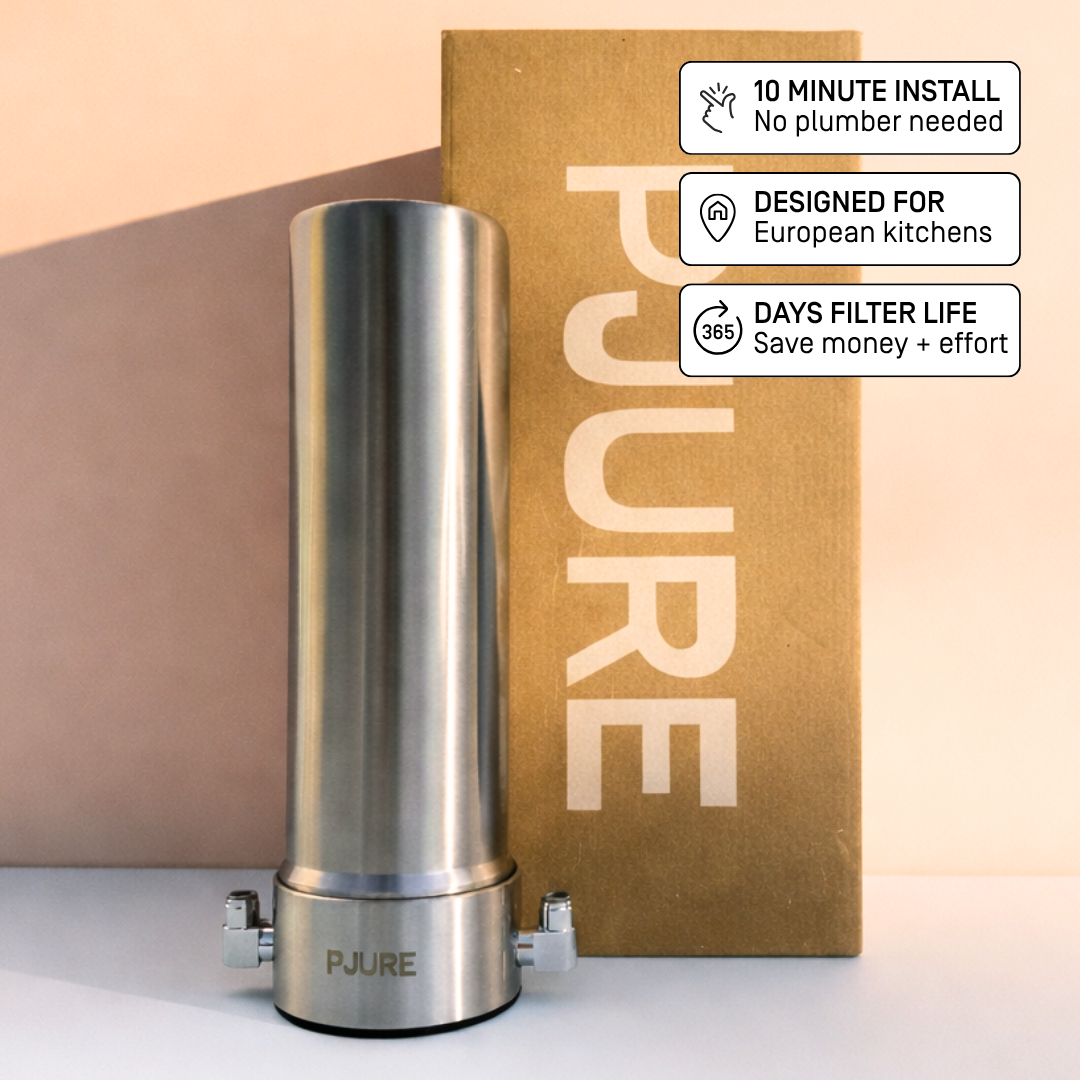
PJURE Stainless Steel Under Sink Filter
What About Reverse Osmosis (RO)?
RO can also reduce PFAS — but with clear trade-offs:
- removes nearly all minerals (WHO notes that mineral-free water may affect taste and hydration efficiency — WHO Drinking Water Report)
- wastes water during the filtration process
- requires larger installation space
For most European homes, a high-performance carbon system is simpler and more sustainable.
Filters That Do Not Remove PFAS
According to EPA and ECHA analyses, the following do NOT meaningfully reduce PFAS:
- basic pitcher filters (most are not certified for PFAS)
- sediment or PP filters
- mineral/alkaline “boosters”
- magnetic or ionizing devices
If the filter doesn’t contain activated carbon → it won’t reduce PFAS.
How PFAS Is Removed: A Simple Explanation
PFAS molecules bind to activated carbon through adsorption — the same mechanism widely used in municipal treatment plants.
Supported by: EPA PFAS Treatment Brief
- PFAS sticks to the carbon surface
- clean water flows through
- PFAS remains trapped until filter replacement
The denser the carbon block → the better the PFAS reduction potential.
Europe’s PFAS Situation: What the Data Shows
PFAS has been detected in water sources across Germany, Belgium, the Netherlands, Denmark, France, Italy and more — according to the European Environment Agency (EEA).
The EU is currently assessing a broad PFAS restriction under REACH, coordinated by ECHA.
The Best PFAS-Reducing Setup for European Homes
- High-quality activated carbon stage (PFAS + chlorine + taste)
- KDF (copper + zinc) for chlorine + metal support
- PP membrane for sediment/pipe particles
- Stainless steel housing for longevity
This approach reduces PFAS while keeping minerals intact — ideal for EU households.
Example system:
PJURE Stainless Steel Under Sink Filter
Conclusion: Yes, You Can Reduce PFAS in Europe
The simplest and most effective method for reducing PFAS at home is:
High-quality activated carbon — ideally inside an under-sink system.
Cleaner taste, mineral-friendly water, and reliable filtration without complexity.
Explore how the PJURE system works:
mypjure.com/products/under-sink-water-filter