PFAS: las "sustancias químicas eternas" de las que todo el mundo habla en Europa. Están presentes en el suelo, los ríos, el agua de lluvia y, en algunas regiones, en el agua del grifo. Y ahora la mayoría de la gente quiere la misma respuesta:
¿Qué filtros de agua reducen realmente los PFAS y cuáles no?
Esta guía te ofrece la versión breve, clara y basada en evidencia. Sin miedo. Sin pánico. Solo lo que funciona en los hogares europeos.
Qué son los PFAS (y por qué les importan a los europeos)
Las PFAS (sustancias perfluoroalquiladas y polifluoroalquiladas) se han utilizado durante décadas en recubrimientos antiadherentes, tejidos impermeables, producción industrial y envasado de alimentos. No se descomponen fácilmente, por lo que acaban en aguas subterráneas y superficiales.
En toda la UE, se han detectado PFAS en fuentes de agua potable según la Agencia Europea de Medio Ambiente (AEMA, 2023) .
Se están implementando nuevos límites a través de la Directiva de agua potable de la UE (2020/2184) , pero muchos consumidores prefieren una filtración adicional en casa.
¿Qué filtros de agua reducen los PFAS?
Seamos extremadamente claros:
El método de consumo más eficaz para reducir los PFAS es el carbón activado de alta calidad.
Con el apoyo de:
- Hoja informativa técnica sobre PFAS de la EPA de EE. UU.
- ACS Environmental Science & Technology (investigación sobre adsorción de PFAS revisada por pares)
- Agencia Europea de Sustancias y Mezclas Químicas (ECHA)
El carbón activado funciona porque las moléculas de PFAS se adhieren a su superficie porosa mediante adsorción. Un carbón más denso significa un mayor rendimiento.
Las 3 tecnologías de filtración que funcionan
1. Bloque de carbón (el más efectivo)
Los filtros de bloque de carbón proporcionan el mayor tiempo de contacto con la superficie y la mayor densidad, lo que los convierte en la mejor opción para la reducción de PFAS.
2. Carbón activado granular (CAG)
Sigue siendo eficaz, pero de menor densidad que el bloque de carbón. Ideal para sistemas multietapa.
3. Ósmosis inversa (OI)
La ósmosis inversa puede reducir los PFAS, pero tiene sus desventajas:
- Elimina casi todos los minerales (la OMS señala que esto puede afectar el sabor y la hidratación — Informe de la OMS sobre el agua potable )
- desperdicia agua
- requiere más espacio de instalación
Para la mayoría de los hogares europeos, los sistemas basados en carbono son la opción más sencilla y sostenible.
Filtros que no reducen los PFAS
Según las revisiones de la EPA y la ECHA, estos filtros NO están diseñados para PFAS:
- filtros básicos de jarra estilo Brita
- Filtros de sedimentos de algodón PP
- “Potenciadores” alcalinos o minerales
- dispositivos magnéticos o ionizantes
Si no incluye carbón activado, no reducirá los PFAS. Así de simple.
¿Qué características tiene un buen filtro PFAS para los hogares europeos?
El sistema ideal de reducción de PFAS debe incluir:
- Carbón activado de alta densidad (GAC + bloque de carbón)
- KDF (cobre + zinc) para soporte de cloro + metales pesados
- Membrana de PP para atrapar sedimentos de tuberías antiguas de la UE
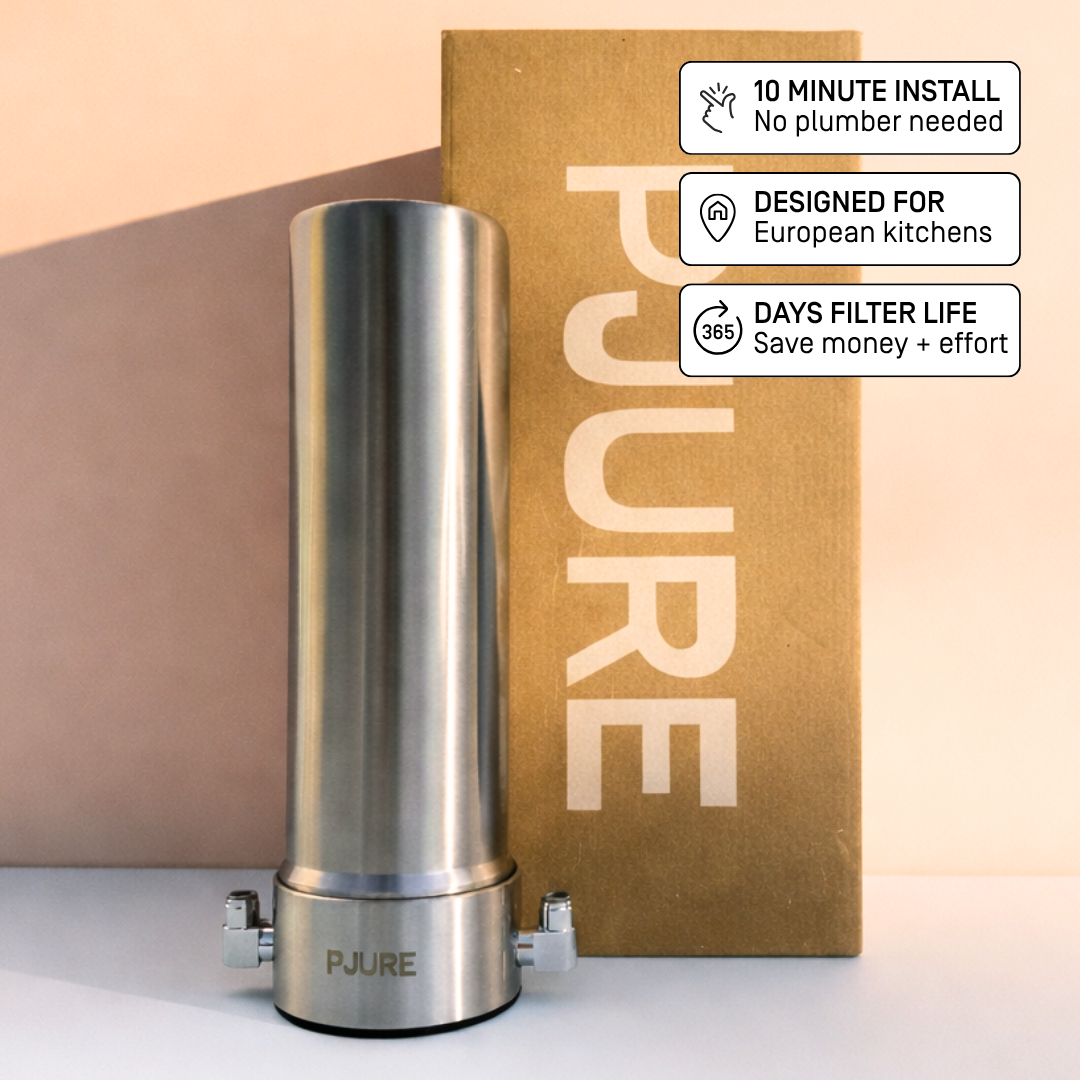
- Carcasa de acero inoxidable para higiene y durabilidad.
- Sin eliminación de minerales : el agua de Europa es naturalmente rica en minerales
Esto proporciona una fuerte reducción de PFAS sin perder sabor ni desperdiciar agua.
Sistema de ejemplo:
Filtro de acero inoxidable para debajo del fregadero PJURE
PFAS en Europa: Qué muestran los datos
Se han encontrado PFAS en fuentes de agua potable en:
- Alemania
- Bélgica
- Francia
- Países Bajos
- Dinamarca
- Italia
- España
Fuente: Agencia Europea de Medio Ambiente .
La UE también está revisando una amplia restricción de PFAS en el marco de REACH, coordinada por la ECHA.
El mejor filtro de agua PFAS para hogares de la UE
Para la mayoría de los hogares, la mejor configuración es:
- carbón activado (GAC + bloque de carbón)
- KDF para reducción de cloro + metal
- Membrana de PP para sedimentos
- carcasa de acero inoxidable
- sin remoción de minerales
Esto equilibra la reducción de PFAS, el sabor, el costo, la sostenibilidad y el uso diario.
Explora el sistema:
mypjure.com/productos/filtro-de-agua-bajo-el-fregadero
Conclusión: Cómo elegir el filtro PFAS adecuado en Europa
Si desea reducir los PFAS en casa, la ciencia es clara:
Elija un sistema de carbón activado de alta calidad con un medio de carbón denso.
Es eficaz, respetuoso con los minerales, asequible de mantener e ideal para los perfiles de agua europeos.
Obtenga más información sobre la reducción de PFAS y las opciones de filtración europeas aquí:
Filtro de acero inoxidable para debajo del fregadero PJURE