Reverse Osmosis (RO) is one of the most powerful water purification technologies in the world — but it comes with a well-known trade-off: it removes minerals. All of them. Calcium, magnesium, potassium… gone.
This guide explains exactly why RO removes minerals, how the technology works, and why many Europeans now prefer mineral-retaining filtration systems instead.
What Reverse Osmosis Actually Does
Reverse Osmosis pushes water through a semi-permeable membrane with extremely small pore size — about 0.0001 microns. This membrane blocks almost everything except pure H2O molecules.
According to the World Health Organization (WHO), RO removes:
- dissolved minerals (calcium, magnesium, potassium)
- salts
- metals
- organic compounds
- PFAS and many contaminants
This is useful in industrial or desalination settings — but it also means RO strips water of its natural mineral composition.
Why RO Removes Minerals: The Technical Explanation
Minerals in water aren’t floating around as “particles” — they exist as dissolved ions (Ca²⁺, Mg²⁺, K⁺, etc.). These ions are extremely small, but still too large to pass through an RO membrane.
Think of it like a molecular sieve: Only pure water fits. Everything else stays behind.
This is why RO removes:
- good minerals
- bad contaminants
- basically everything except H2O
The result is “demineralized” or “low TDS” water.
What WHO Says About Demineralized Water
WHO has published multiple documents discussing the potential downsides of very low-mineral water, especially when consumed long-term.
From WHO’s Nutrients in Drinking Water report:
- minerals in water are “highly bioavailable”
- water low in minerals may have “poor taste and low consumer acceptability”
- calcium and magnesium are beneficial for electrolyte balance
WHO also notes that consuming water with little or no minerals is not ideal for hydration efficiency.
Why Minerals in Water Matter for the Body
European tap water naturally contains calcium and magnesium — important electrolytes.
Peer-reviewed studies show:
- Magnesium from water is absorbed extremely well (Sabatier et al., 2002)
- Calcium in hard water is highly bioavailable (Brink et al., 2008)
- Minerals in water support natural electrolyte balance (WHO)
This is why many Europeans prefer water that retains its natural mineral profile.
Why People Choose RO (And Why Many Switch Away)
RO is chosen for:
- very high contaminant removal
- desalination (coastal areas)
- specific medical uses
People switch away because:
- water tastes flat without minerals
- it may feel less hydrating
- RO wastes water during filtration
- systems are larger and more complex
- mineral removal requires re-mineralization cartridges
In many cases, mineral-friendly carbon filtration is a simpler everyday solution — especially in Europe.
RO vs Activated Carbon (Mineral-Friendly Filtration)
Reverse Osmosis:
- removes minerals
- removes salts
- removes PFAS
- removes everything except pure water
Activated Carbon Systems:
- remove PFAS (EPA)
- remove chlorine, VOCs, microplastics (ACS ES&T Research)
- keep minerals intact
- improve taste
- require no electricity or wastewater
For most households, this is the sweet spot: clean water + natural minerals.
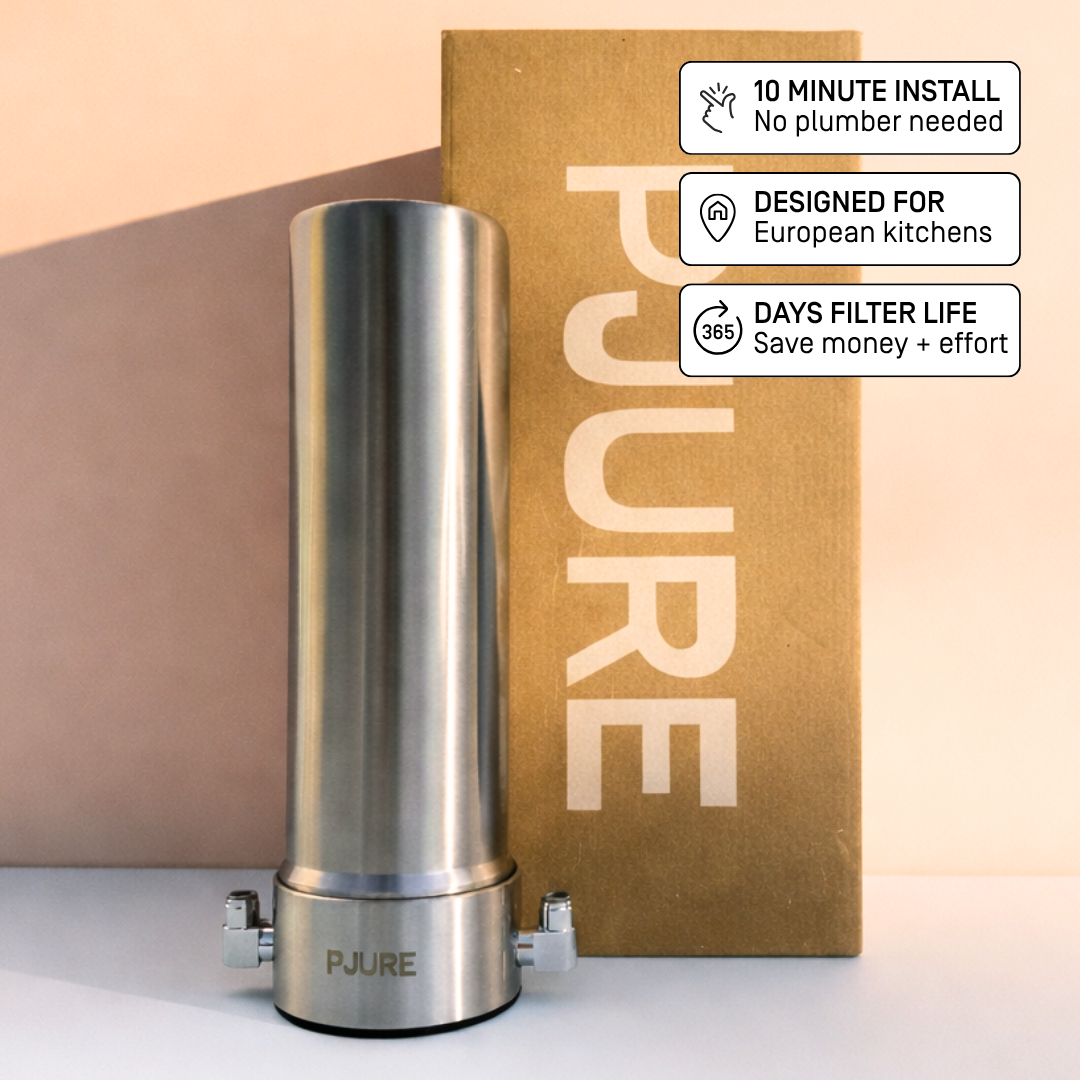
The Mineral-Friendly Alternative (PJURE)
PJURE’s stainless steel under-sink system uses:
- Coconut activated carbon
- KDF (copper + zinc)
- PP sediment membrane
It removes contaminants — not minerals.
Explore how the system works:
PJURE Stainless Steel Under Sink Filter
Conclusion: RO Removes Minerals Because It Removes Almost Everything
Reverse Osmosis isn’t “bad” — it’s just extremely aggressive purification. That’s why it removes minerals: the membrane is designed to block nearly all dissolved substances.
For everyday use, many Europeans choose mineral-retaining systems because they:
- keep natural electrolytes
- taste better
- hydrate better
- require less maintenance
- are more sustainable
If you want clean water without losing minerals, a carbon-based system is the right match.
Discover PJURE → mypjure.com/products/under-sink-water-filter