Wasserwissen – Einblicke in sauberes Wasser und Filtration

Best PFAS Water Filter for European Homes (2025 Guide)
PFAS are increasingly detected in European water sources. This guide explains which water filters actually reduce PFAS and what works best for European homes.
Erfahren Sie mehrIs Tap Water Safe in Italy? What You Should Know in 2025
Is Italian tap water safe to drink? Yes — by law. But taste, chlorine and PFAS concerns lead many households to filter their water. Here’s what to know in 2025.
Erfahren Sie mehrIs Tap Water Safe in France? (2025 Guide)
Is tap water in France safe to drink? This guide explains French water quality regulations, chlorine, PFAS concerns and why many households choose to filter their tap water.
Erfahren Sie mehrBest Water Filter for Renters in Europe (2025 Guide)
The best water filter options for renters in Europe. Non-permanent, landlord-friendly systems that improve taste, reduce chlorine and PFAS without drilling.
Erfahren Sie mehrWhy Reverse Osmosis Removes Minerals (EU 2025 Guide)
Learn why reverse osmosis (RO) removes minerals like calcium and magnesium, how RO membranes work, and why mineral-retaining filtration is preferred in Europe.
Erfahren Sie mehrStainless Steel Under Sink Water Filter: Why It’s the Better Choice (EU 2025 Guide)
Learn why stainless steel under-sink water filters outperform plastic systems. Hygiene, durability, microplastic reduction, mineral retention and EU water quality.
Erfahren Sie mehrPJURE vs Brita: Full Comparison for Europe (2025 Guide)
A complete, evidence-based comparison of PJURE vs Brita for European households. Filtration performance, PFAS reduction, mineral retention, taste, sustainability and more.
Erfahren Sie mehrMineral Water Filter: Why Minerals Matter (EU 2025 Guide)
Learn why minerals matter in drinking water, how they support hydration and electrolyte balance, and which filters remove contaminants without stripping minerals.
Erfahren Sie mehrPFAS Water Filter EU Buyer’s Guide (2025 Update)
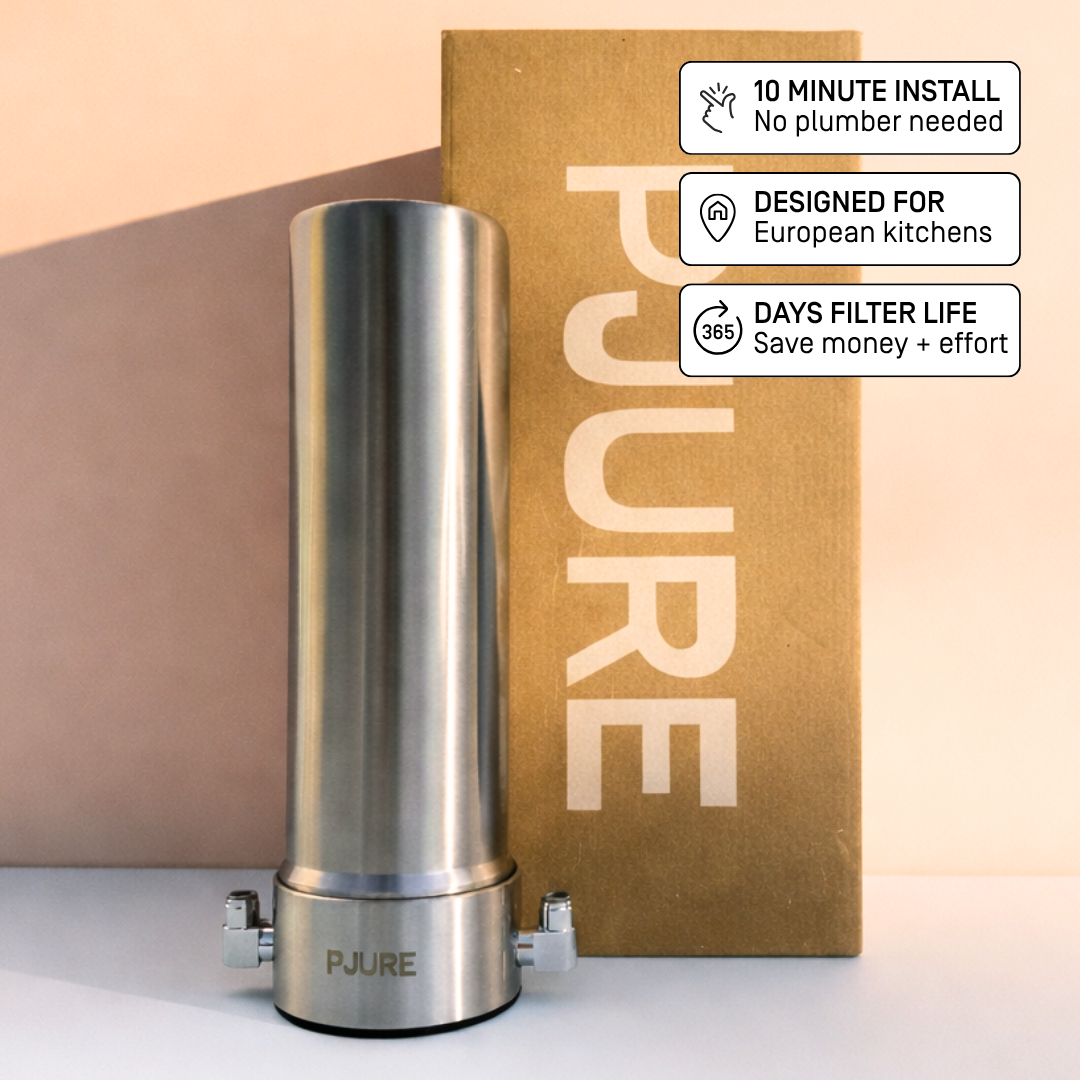
PFAS — the “forever chemicals” everyone in Europe keeps talking about. They’re in soil, rivers, rainwater and, in some regions, tap water. And now most people want the same answer: Which water filters actually reduce PFAS — and which ones don’t? This guide gives you the short, clear, evidence-based version. No fear. No panic. Just what works in European homes. What PFAS Are (and Why Europeans Care) PFAS (per- and polyfluoroalkyl substances) have been used for decades in non-stick coatings, waterproof fabrics, industrial production and food packaging. They don’t break down easily — which is why they end up in ground- and surface water. Across the EU, PFAS has been detected in drinking water sources according to the European Environment Agency (EEA, 2023). New limits are being implemented through the EU Drinking Water Directive (2020/2184), but many consumers prefer additional filtration at home. Which Water Filters Reduce PFAS? Let’s be extremely clear: The most effective consumer-grade method for reducing PFAS is high-quality activated carbon. Supported by: U.S. EPA PFAS Technical Fact Sheet ACS Environmental Science & Technology (peer-reviewed PFAS adsorption research) European Chemicals Agency (ECHA) Activated carbon works because PFAS molecules stick to its porous surface through adsorption. Denser carbon = stronger performance. The 3 Filtration Technologies That Work 1. Carbon Block (Most Effective) Carbon block filters provide the highest surface contact time and density, making them the top choice for PFAS reduction. 2. Granular Activated Carbon (GAC) Still effective, but lower density than carbon block. Ideal in multi-stage systems. 3. Reverse Osmosis (RO) RO can reduce PFAS, but comes with downsides: removes nearly all minerals (WHO notes this may affect taste and hydration — WHO Drinking Water Report) wastes water requires more installation space For most European households, carbon-based systems are the simpler, more sustainable option. Filters That Do Not Reduce PFAS Based on EPA and ECHA reviews, these filters are NOT designed for PFAS: basic Brita-style pitcher filters PP cotton sediment filters alkaline or mineral “boosters” magnetic or ionizing devices If it doesn’t include activated carbon → it won’t reduce PFAS. Simple as that. What Makes a Good PFAS Filter for European Homes? The ideal PFAS-reducing system should include: high-density activated carbon (GAC + carbon block) KDF (copper + zinc) for chlorine + heavy metal support PP membrane to catch sediment from older EU plumbing stainless steel housing for hygiene + durability no mineral removal — Europe’s water is naturally mineral-rich This gives strong PFAS reduction without stripping taste or wasting water. Example system:PJURE Stainless Steel Under Sink Filter PFAS in Europe: What the Data Shows PFAS has been found in drinking water sources across: Germany Belgium France The Netherlands Denmark Italy Spain Source: European Environment Agency. The EU is also reviewing a broad PFAS restriction under REACH, coordinated by ECHA. The Best PFAS Water Filter for EU Homes For most households, the best setup is: activated carbon (GAC + carbon block) KDF for chlorine + metal reduction PP membrane for sediment stainless steel housing no mineral removal This balances PFAS reduction, taste, cost, sustainability and everyday use. Explore the system:mypjure.com/products/under-sink-water-filter Conclusion: Choosing the Right PFAS Filter in Europe If you want to reduce PFAS at home, the science is clear: Choose a high-quality activated carbon system with dense carbon media. It’s effective, mineral-friendly, affordable to maintain and ideal for European water profiles. Learn more about PFAS reduction and European filtration options here:PJURE Stainless Steel Under Sink Filter
Erfahren Sie mehr